Alice
Mariners' Museum, Uncurated Search Results
Type: Pungy
Year:
Builder:
Location:

These records are found in the online catalog of The Mariners’ Museum and Park in Newport News, Virginia. Uncurated search results are presented to give researchers and interested readers an idea of whether the museum’s archives contain information about this vessel and whether it may be worthwhile to visit the museum’s catalog search page for further investigation. Uncurated results may be inaccurate or incomplete.
Search mode: Type+Name. Search phrase(s): "Pungy Alice"; "Schooner Alice". Results returned: 3. Results displayed in this table: 3.
| Fetch? | Row ID | Media | Date | Vessel | Place | Related Places | Inscription/Marks | Subject | Notes | Archive Number |
|---|---|---|---|---|---|---|---|---|---|---|
| 1 | 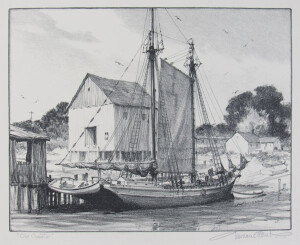 | VESSEL INFORMATION - VESSEL NAME: ALICE S. WENTWORTH VESSEL BUILT: 1863 VESSEL TYPE: TWO MASTED SCHOONER BUILDER LOCATION: SOUTH NORWALK, CONNECTICUT VESSEL HISTORY: Owned in 1925 first record owner, by Z.N. Tilton, Vineyard Haven, Mass. Owner in 1927, Edward C. Lord, Vineyard Haven; in 1938, Ralph M. Packer, Vineyard Haven; in 1939; Schooner ALICE S. WENTWORTH Associates, New Bedford, Mass. in 1944, J. Parker Hall, New Bedford; in 1946, Hosea B. Phillips, Bar Harbor, Maine. Alternate vessel names: (1) LIZZIE A. TOLLES (SCHOONER 1863-1904); (2) ALICE S. WENTWORTH (SCHOONER: 1905-1974). | CL8091 | |||||||
| 2 | 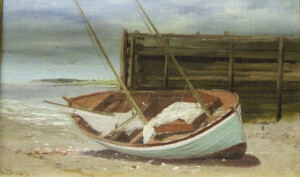 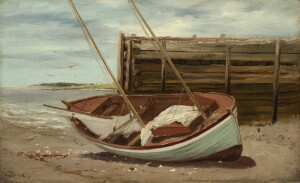 | SHORT DESCRIPTION: Oil painting on canvas by artist Milton J. Burns titled “Beached Boat Near Dock”. The image shows a small two-masted fishing boat laying on its starboard side on the beach at low tide. Its sails lay in the bottom of the boat behind each mast. A tall, boarded wharf or dock sits behind it at the right. The bay is visible in the background at the left. NOTES: [John Sands] I found a similar boat and dock in a photograph of Grand Manan Island in the collection of the Grand Manan Historical Society (there is a copy in the Albert Barnes Collection). The boat has a similar hull form and cuddy cabin. The boats in the photograph have a single stayed mast while in our painting Burns has depicted the boat with two unstayed masts. [Lyles Forbes] My best assumption regarding the boat near the dock is that it is a type of Crotch Island pinky, used mostly in Maine and along coastal New England. NOTES: The Bay of Fundy experiences some of the highest tides in the world, reaching up to 53 feet in vertical elevation. Grand Manan island is located in the middle of the bay about 32 kilometers from New Brunswick. NOTES: [J. Willoz-Egnor, June 5, 2023] Excerpts from Milton J. Burns, Marine Artist, by Peter Hastings Falk: Milton James Burns was born in Mt. Gilead, Ohio on January 9, 1853. After developing a serious eye-ailment, his doctor recommended he go to sea where the salt air would help alleviate the problem. On July 3, 1869, at the age of sixteen, Burns joined the crew of the 325-ton Canadian whaling steamer Panther, which was headed to the Arctic from St. John’s, Newfoundland. Panther had been chartered by artist William Bradford for an extensive expedition that eventually covered over 1,000 miles of Greenland’s coastline. During this voyage Bradford awakened and guided Burns’ artistic inclinations. When the Panther voyage ended, Burns took art classes at the National Academy of Design in New York, but most of his formal training occurred while under the tutelage of artist John George Brown. Brown encouraged his students to paint from life and to look to nature for inspiration. It was a philosophy Burns strictly adhered to and it was his passion for the ocean and the people that worked on it that drove his artistic career forward. Burns served on several sailing ships as he continued his art education. He became friends with Winslow Homer in the early 1870s and the style, technique, and subject matter of his drawings of the time reflect Homer’s influence. In turn, at least one of Homer’s artworks was influenced by a true account his friend Burns had experienced at sea (Lost on the Grand Banks). Burns became a freelance illustrator in the early 1870s, later working regularly for Harper’s, Scribner’s and other leading publishers. In the 1870s and 1880s Burns frequently traveled to the coast of Maine, Grand Manan, Mount Desert and Monhegan Island to draw and paint. Burns got closer to his subject and took more risks than most artists to instill a sense of truth in his artistic works. The result was realistic, vigorous, dramatic, and often heroic illustrations. A reporter with American Art News stated in 1914 “[Burns] painted them [fisher boats and folk along the New England coast and on the Grand Banks] vividly and strongly, for he shared the perils of the life and mixed his oils with more than a dash of sea salt.” Another stated his paintings had “all the smack and braciness of the true salt feeling.” In March 1881, he and author-artist S. G. W. Benjamin joined the pilot schooner Caprice to document life aboard a pilot boat as it cruised nearly 500 miles out into the Atlantic in a full winter gale. The editors of The Century were so impressed by Burns’ images, they commissioned the men to take a longer cruise into foreign waters. Benjamin and Burns chartered the 59’ coasting schooner Alice May for a circumnavigation of the Gulf of St. Lawrence. The Century published a six-part series that was later published as the book The Cruise of the Alice May in the Gulf of St. Lawrence and Adjacent Waters. In 1881, Burns also made his first trip to England’s North Sea coast where he sailed with the fishing fleets near Lowestoft. Burns struggled with two separate careers: illustrator and painter. While his notoriety and income came largely from his illustration work, he was a serious artist in oils. Author-artist S. G. W. Benjamin stated “[Burns] had made a specialty of marine genre in which he has few superiors.” While prolific, Burns’ formal artistic works brought little income. The problem can partly be attributed to the fact that Americans of the time weren’t avid collectors of American paintings and remarkably, paintings of marine scenes were unsaleable subject matter. Despite his financial problems, Burns’s reputation as a marine illustrator kept him sailing for publishers from Newfoundland’s Grand Banks to Great Britain’s Dogger Banks; from Hudson’s Bay down to the Caribbean and South America; and to the Arctic tundra’s from Alaska to Norway. Eventually, wood-engraved illustrations were replaced with the photomechanical process of halftone reproduction which was subsequently replaced by photography making the role of illustrators obsolete. In 1910 Burns chartered a 120-ton schooner for a sketching cruise with the fishing fleets on the Grand Banks of Newfoundland. The illustrations were published by the London Graphic and commissions from other British publishers followed. Burns remained in Britain for a long period, painting and illustrating his favorite areas along the North Sea coast from Lowestoft, England to Wick, Scotland. He shipped out with fishing fleets for weeks at a time to the dangerous Goodwin Sands or the frigid waters of Iceland. During World War I Burns was commissioned by Admiral William S. Sims to document the Navy’s offensive operations against the German fleet. After the war he continued working as a free-lance illustrator. He bought a boat, which he lived on for the rest of his life. In 1932 Burns fell ill in France, returned to New York, and died there the following winter (December 27, 1933). | CL6952 | |||||||
| 3 | 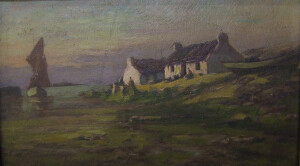 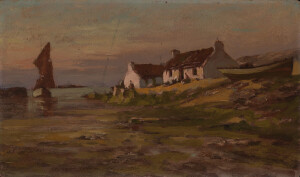 | SHORT DESCRIPTION: Oil painting on board by Milton J. Burns titled “Twilight, Fisherman’s Home: Scotland.” The image shows a house at dusk sitting on a rocky, mossy-looking shoreline. The house sits at the center left. It is white with chimneys at either end. A similar small building sits slightly behind it to the left. A fishing boat is pulled up on the shoreline to its right. At the left, a boat is sailing into the small harbor. The final light of the sun is reflecting on the clouds behind it. Rocks sit in the water in the foreground. The painting is unsigned. NOTES: [J. Willoz-Egnor, June 5, 2023] Excerpts from Milton J. Burns, Marine Artist, by Peter Hastings Falk: Milton James Burns was born in Mt. Gilead, Ohio on January 9, 1853. After developing a serious eye-ailment, his doctor recommended he go to sea where the salt air would help alleviate the problem. On July 3, 1869, at the age of sixteen, Burns joined the crew of the 325-ton Canadian whaling steamer Panther, which was headed to the Arctic from St. John’s, Newfoundland. Panther had been chartered by artist William Bradford for an extensive expedition that eventually covered over 1,000 miles of Greenland’s coastline. During this voyage Bradford awakened and guided Burns’ artistic inclinations. When the Panther voyage ended, Burns took art classes at the National Academy of Design in New York, but most of his formal training occurred while under the tutelage of artist John George Brown. Brown encouraged his students to paint from life and to look to nature for inspiration. It was a philosophy Burns strictly adhered to and it was his passion for the ocean and the people that worked on it that drove his artistic career forward. Burns served on several sailing ships as he continued his art education. He became friends with Winslow Homer in the early 1870s and the style, technique, and subject matter of his drawings of the time reflect Homer’s influence. In turn, at least one of Homer’s artworks was influenced by a true account his friend Burns had experienced at sea (Lost on the Grand Banks). Burns became a freelance illustrator in the early 1870s, later working regularly for Harper’s, Scribner’s and other leading publishers. In the 1870s and 1880s Burns frequently traveled to the coast of Maine, Grand Manan, Mount Desert and Monhegan Island to draw and paint. Burns got closer to his subject and took more risks than most artists to instill a sense of truth in his artistic works. The result was realistic, vigorous, dramatic, and often heroic illustrations. A reporter with American Art News stated in 1914 “[Burns] painted them [fisher boats and folk along the New England coast and on the Grand Banks] vividly and strongly, for he shared the perils of the life and mixed his oils with more than a dash of sea salt.” Another stated his paintings had “all the smack and braciness of the true salt feeling.” In March 1881, he and author-artist S. G. W. Benjamin joined the pilot schooner Caprice to document life aboard a pilot boat as it cruised nearly 500 miles out into the Atlantic in a full winter gale. The editors of The Century were so impressed by Burns’ images, they commissioned the men to take a longer cruise into foreign waters. Benjamin and Burns chartered the 59’ coasting schooner Alice May for a circumnavigation of the Gulf of St. Lawrence. The Century published a six-part series that was later published as the book The Cruise of the Alice May in the Gulf of St. Lawrence and Adjacent Waters. In 1881, Burns also made his first trip to England’s North Sea coast where he sailed with the fishing fleets near Lowestoft. Burns struggled with two separate careers: illustrator and painter. While his notoriety and income came largely from his illustration work, he was a serious artist in oils. Author-artist S. G. W. Benjamin stated “[Burns] had made a specialty of marine genre in which he has few superiors.” While prolific, Burns’ formal artistic works brought little income. The problem can partly be attributed to the fact that Americans of the time weren’t avid collectors of American paintings and remarkably, paintings of marine scenes were unsaleable subject matter. Despite his financial problems, Burns’s reputation as a marine illustrator kept him sailing for publishers from Newfoundland’s Grand Banks to Great Britain’s Dogger Banks; from Hudson’s Bay down to the Caribbean and South America; and to the Arctic tundra’s from Alaska to Norway. Eventually, wood-engraved illustrations were replaced with the photomechanical process of halftone reproduction which was subsequently replaced by photography making the role of illustrators obsolete. In 1910 Burns chartered a 120-ton schooner for a sketching cruise with the fishing fleets on the Grand Banks of Newfoundland. The illustrations were published by the London Graphic and commissions from other British publishers followed. Burns remained in Britain for a long period, painting and illustrating his favorite areas along the North Sea coast from Lowestoft, England to Wick, Scotland. He shipped out with fishing fleets for weeks at a time to the dangerous Goodwin Sands or the frigid waters of Iceland. During World War I Burns was commissioned by Admiral William S. Sims to document the Navy’s offensive operations against the German fleet. After the war he continued working as a free-lance illustrator. He bought a boat, which he lived on for the rest of his life. In 1932 Burns fell ill in France, returned to New York, and died there the following winter (December 27, 1933). | CL22259 |
Created 2026 by Don Barker, CBMM volunteer, for the Chesapeake Shipbuilding Project. shipbuilding@sailingworkboats.es
hacksneckpungoteague